Common sense design for the harsh Maine climate
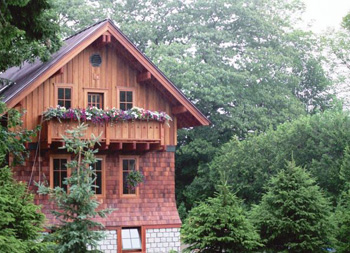
Marine Avenue house
My intentions in building this home from conception to finish were many, but high on the list of priorities was to build green; a home that would require the least amount of exterior maintenance as possible and with as high a level of energy conservation as my budget would allow.
After 35 years of designing and building homes, experience and conscience dictates now more than ever that I build not only for protection from the Maine climate, but also something that will protect itself from the ever changing political climate as well. There is little that any of us can do about the escalating cost of property tax or home energy costs. But there are more than ample opportunities for architects and builders to help offset those rising tax and energy costs by making homes far more energy efficient and far less high maintenance.These two account for more wasted money, time, and energy fuel than anyone can imagine and that's how it goes in Maine. More needs to be done; education helps, but building better is better still.
Wood rot is a living organism that eats the natural glue that holds fibers together in wood. All wood, to varying degrees is susceptible to rot. Rot is very active when temperatures are between 60 degrees and 90 degrees Fahrenheit, and when the moisture content of wood approaches 20% which it will do under repeated wetting conditions, even if it is painted. These conditions exist on a regular basis in Maine during the Spring, Summer, and Fall. So rot has a good environment for growth.
In America we build our houses primarily out of wood, while in Europe, houses have been built primarily out of masonry of one type or another for centuries. Our reasons for building primarily with wood are two fold. Wood is cheaper and faster to build with than masonry, and historically we have had a lot of trees to make lumber with. In Maine nearly all the homes are made of wood. The early settlers, most of them poor, needed a fast and inexpensive way to put up a house. Stick framed with clapboard exterior and no roof overhang was and still is the fastest way. Roofs, which should protect a wooden home from rain, were built with little or no overhangs; one reason for building this type of roof is because it basically is the type of architecture Europeans had become accustomed to seeing on carved stone buildings of the great cities of Europe, from ancient Greece on to the more modern cities of the time. But the more obvious reason was simply because it was and still is the cheapest and easiest way to build a roof. The early settlers were not so much concerned with longevity in a house as they were with getting it up before winter arrived. It is a style that over the years has stuck, been imitated and reused over and over even now. I know of two waterfront homes in the area each currently undergoing rot repairs well in excess of $100,000 each. One home is only ten years old, the other home was completely and professionally rebuilt only fifteen years ago. Properly designed a large overhanging roof would have prevented this deterioration totally. And so that is the problem. Wood homes with short roof overhangs are prone to serious water damage. To the contrary stone buildings and stone window sills don't rot and their architectural styles should not be imitated in wood; and painting wood is simply not the solution. Paint does a better job of hiding rot than preventing it.
Vertical facias on the eve side of a roof simply have no place in wood home construction. They are so prone to water running off the roof (even if there is a gutter) that they are one of the first things that need repair. Enclosed soffats simply add to the problem by hiding the rot. Gutters, which frequently fail, speed up the deterioration. Covered in paint rotten facias and soffats are not immediately apparent, but in time the rot spreads into the rafters and only when a chronic peeling paint problem is addressed, is it discovered that the rot has gotten into the walls as well. Frequently it's only a matter of a few years before this starts to happen. Ancient wooden buildings that are in original condition have open rafter tails, cut back out of the way of driving rain. From the ground up the problems are even worse. Rain blowing on wood siding causes sills and the bottoms of studs to rot. Clapboards, tar paper and the various paper house raps offer no protection over time.
After years of watching these chronic problems repeated over and over on the coast of Maine I was puzzled for awhile how it could be, until it dawned on me that tradition was dictating the style of architecture more than common sense.
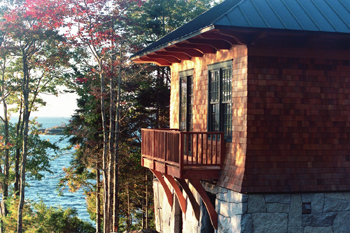
East Blue Hill house
I decided that there was a better way. I looked at ancient wooded buildings in Japan and Europe, both having climates similar to Maine's climate. I was amazed to see how long wood buildings could stand without reconstruction if they are kept dry. Wood that is kept dry will last many hundreds of years without loosing it's structural integrity. The two things that all of these old homes had in common were tall masonry foundations and large extended roof overhangs. Combine these practices with building with wood that has a naturally high rot resistance and one finds an incredibly durable structure. Properly designed a large overhanging roof does not block out the vital sun rays of winter.
But it is not cheap to build this way. Masonry is always the most expensive part of home construction. Large overhanging roofs are complex and costly as well, especially if wind and snow loads are taken into account.
Undaunted, I followed my conscience and decided to put these practices to use in my next home in Maine. I built the lower four and a half feet of the house with granite so that splashing rainwater had no place for rot. I built a roof using heavy timbers and rafters that extend a full four feet beyond the house all around. What a difference it makes. As I write this, rain is coming down in buckets and there is a breeze out as well. Yet I can walk all around the house under the overhangs and not get wet. The windows and siding are dry, even the stonework is dry. All of the exterior beams that hold up the balconies and deck are permanently sealed against rot with ice and water shield and lead flashing. The water running off the roof falls well away from the foundation helping add to the longevity of the life of this home. And yet sitting inside the living room looking out the tall windows I don't even see the roof overhang. The ceilings are almost ten feet and the room is filled with light. Now I'm glad that I went to all the extra work and expense. It just makes sense. For the roof I used a standing seam metal roof. It should last several lifetimes. All this may seem like a topic hardly worth discussing, but there are many people on the coast of Maine who wish they could do something about their rising cost of property taxes, utility bills and home maintenance repairs.
Utility bills, specifically the cost of keeping our homes warm in the winter are getting higher and there is no end in sight. I made a point to put the best and maximum amount of insulation in the house. The insulation is foam panels, each one sealed airtight to every stud and rafter. Every crack and crevice was filled with foam. To prevent moisture buildup, the roof and even the stone walls have ventilation to the outside. The open beamed ceiling allows the warm air from downstairs to rise through the floor instead of escaping through the top of the walls at a ceiling barrier. Because the house is so tightly built and insulated even to the point where outside noises are barely audible, an energy recovery ventilator was installed giving each room a constant supply of fresh air from outdoors, while removing used air from indoors without the loss of indoor heat. The freshness of the air is immediately noticeable upon entering the house. The air quality makes it a delight to be inside.
Heat loss calculations were done by two separate heating engineers and the house rated very well. The house's good exposure to the winter sun helps make it especially easy to heat in the winter. The large trees on the northern 180 degrees of the compass help cradle the sun's rays, while the hedge height arborvitae cedars on the southern 180 degrees of the compass provide privacy and seclusion.
The interior décor speaks for itself. The extensive wood detailing throughout, using only the finest woods with yacht finishes, immediately sets the house apart with a warm amber glow. Wooden ship knees, large beams, Douglas fir flooring throughout, and raised paneled walls give the home as much a feeling of being on a wooden boat as in a house. I installed spiral staircases; they save space and contrary to our initial concerns we were able to carry everything up them except large box springs. Foreseeing this I installed a simple block and tackle off the exterior ridge beam above the balconies, and in less than five minutes I am able to haul a large mattress upstairs, onto the balcony and in through the door, by myself and with less effort than two men carrying it up straight stairs.
The Swiss made hot water radiators, each one designed and built for the necessary requirement of each specific area of the home, and are as much a piece of sculpture as they are a radiant heat source.
Although I call it a three bedroom, three bath home it could just as easily be a four bedroom home with office space as well, depending on how one chooses to use the ample extra space downstairs.
It is a house that could easily be added on to without disrupting the existing structure. There is ample room behind the house to add on several thousand more feet of living space or an enlarged garage should it be needed. Such an addition could be higher in elevation, and would increase the views to the bay. At the bottom of Marine Avenue, not a three minute walk, is the seldom used and little known public access to Camden Harbor and the rocky beach. Marine Avenue is not a through street so there is little traffic; just a quiet neighborhood of friendly supportive people. With the new sidewalk/bike path along High Street it's little more than a five minute walk to the head of Camden Harbor where the shops are.
The bedroom balconies and their flower boxes give this in-town home a feeling of a European Villa and there is room on each balcony for a small table and chair. From the master bedroom balcony there is a surprising view across Islesboro and to the mountains beyond Penobscot Bay. I've built the house in such a way that a combined solarium/entry foyer would not be difficult to add if desired. In addition the deck could be easily extended around the end of the house. While I wanted to keep lawn maintenance to a minimum by keeping it small, the pea stone which covers most of the yard could be easily removed and a grass lawn put in. I planted 84 trees, mostly all large evergreens, one half of which are on the northern 180 degrees of the compass and will grow considerably larger. They give protection from the cold north and catch the sun's rays from the south in the winter. The remaining half of the trees that I planted are on the southern 180 degrees of the compass and are arborvitae cedars which can be maintained at a height high enough to provide privacy but low enough to allow the winter sun to come in. There is no basement as the bottom floor is only three feet below grade and five feet above grade, with large windows starting at waist height so there is lots of light. The house has been described by some as being the perfect home for entertaining, a seemingly odd description to me, as I rarely entertain but prefer the peace and solace it offers; as much a family home as a home for a couple or a single person.
Marc Scott, Builder
© 2026 Marc Scott | All rights reserved
Clean Web Design Colorado